


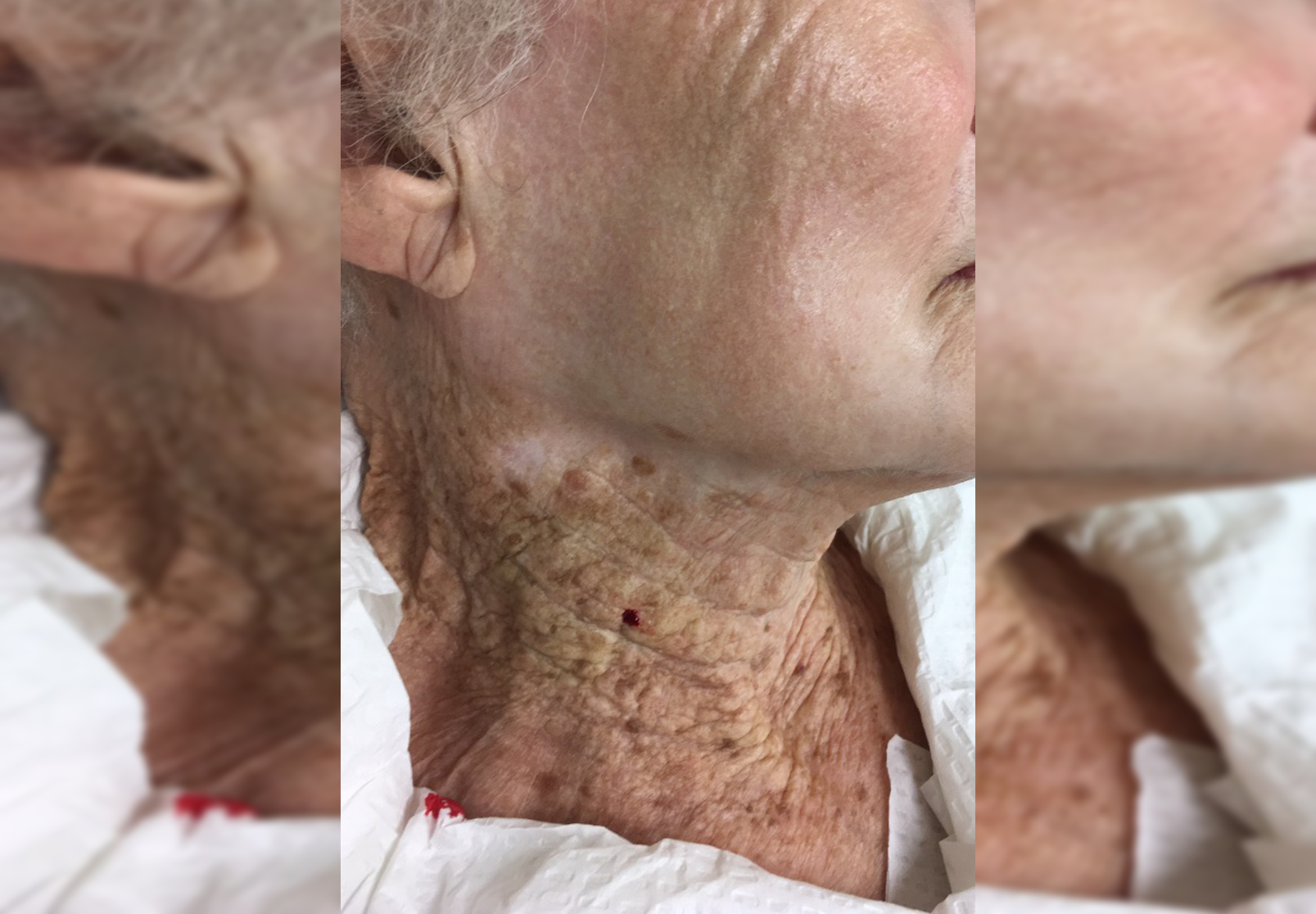
A photo of a 92-year-old woman has been making the rounds, and it shows something I try to explain to patients every summer.
The image appeared in a 2021 commentary in the Journal of the European Academy of Dermatology and Venereology. According to the report, she used a UV-protective moisturizer on her face for years. She never put it on her neck.
The difference in visible sun damage between the two areas is striking. Same woman. Same genes. Same birthday. The only real difference between those two patches of skin is how much ultraviolet light reached them.
That contrast is worth a closer look. The sun does more than add wrinkles. The damage that makes skin look old is closely tied to the damage that leads to skin cancer.
Photoaging vs. Chronological Aging: Why Your Neck Can Look Older Than Your Face
Doctors split skin aging into two types.
Chronological aging is what happens with time alone. Skin gets thinner, drier and less elastic as the years pass, no matter what you do.
Photoaging is the extra aging caused by sun exposure. UV rays penetrate the layers of your skin and damage the cells there, along with the collagen and elastin fibers that keep skin firm.
Your skin is one of the few organs that faces the environment directly. That’s why the areas that see the most sun (face, neck, arms, hands) usually look older than the areas that stay covered, like your stomach or back. Compare the skin on the back of your hand to the skin on your upper arm and you’ll see it for yourself.
The neck is an easy area to miss. Many people apply sunscreen or SPF moisturizer to the face and stop at the jawline. Years of that habit can show up exactly the way it did in this photo.

How UV Rays Damage Skin-Cell DNA and Raise Cancer Risk
Wrinkles are the part of sun damage you can see. The part you can’t see is happening inside the DNA of your skin cells.
UV radiation causes direct damage to DNA. Your body repairs most of it. Some of it slips through, and those errors build up with every sunburn and every unprotected afternoon outside. The more errors a cell carries, the higher the chance that one of them hits a gene controlling cell growth. That’s how skin cancer starts.
Skin cancers are the most common cancers in people with light skin tones. They include basal cell carcinoma, squamous cell carcinoma and melanoma. All three are strongly linked to UV exposure.
So the sun drives aging and cancer through overlapping damage. The same skin that looks older from sun exposure is often the skin carrying more cancer risk.
Dr. Christian Posch’s Argument: Aging and Skin Cancer Share the Same Hallmarks
The photo was part of a commentary by Dr. Christian Posch, a specialist in skin cancer research. His point goes further than “wear sunscreen.”
Posch notes that older age is the single greatest risk factor for skin cancer. Part of that is simply decades of sun adding up. But he argues that aging itself, the biology happening inside our cells regardless of outside exposure, also drives skin cancer.
His reasoning: the hallmarks of aging and the hallmarks of cancer overlap substantially. Fix one and you work on the other.
“While it is unlikely that we can (or even should) aim at defeating human ageing for various reasons, modifiers of ageing will still be able to change both healthspan (the time we live without disease) and lifespan. After all, who would not agree to an additional 20–40 healthy years?”
He also makes a frank admission. Current prevention campaigns, from tanning bed bans to sun-safety apps, are unlikely to be enough on their own as populations get older. Prevention has to target both outside threats (UV radiation, pollution) and the inside changes that come with age.

The Aging Changes Linked to Skin Cancer
Posch points to a few specific aging processes that set the stage for skin cancer.
Senescent cells. These are cells that have stopped dividing but refuse to die. They keep releasing inflammatory signals into the surrounding tissue. Researchers call this low-grade, constant inflammation “inflammaging,” and it helps tumors grow. In animal studies, clearing out these cells significantly reduced how often skin cancers appeared. Drugs that remove senescent cells (senolytics) or block their inflammatory signals (senomorphics) are being studied, but they aren’t ready for routine use in people.
There’s a catch. Senescence also does useful work, including wound healing and stopping some damaged cells from turning cancerous. Any future treatment will need to target the harmful cells and leave the helpful ones alone.
Weaker DNA repair. When you’re young, your cells are good at fixing DNA damage or destroying cells that can’t be fixed. With age, that repair system slows down. Levels of NAD+, a molecule the repair machinery depends on, drop in older tissue, along with key repair proteins. At the same time, worn-out mitochondria (the energy centers of your cells) create more internal damage.
Other changes. Posch also lists mitochondrial dysfunction and impaired autophagy, the process cells use to clear out their own damaged parts.
He’s clear that there’s no single fix. People age at different rates, and even different organs in one person age differently. He expects the future of prevention to look like personalized combinations of approaches, possibly even fortifying foods or water, the way we add iodine to salt. He also stresses that people will still develop skin cancer no matter how good prevention gets, so better treatment matters just as much.
My Personal RX on Daily Sun Protection That Doesn’t Stop at Your Face
That photo is the best argument for daily sunscreen I’ve seen in a long time. It also shows how easy it is to protect one area and forget the one right next to it. Most of the sun damage I see in older patients comes from habits, and habits can change at any age.
Here’s what I want you to do starting this week.
- Wear broad-spectrum SPF 30 or higher every day. Rain, clouds or winter, UV still reaches your skin. Make it part of brushing your teeth.
- Take it past your jaw. Apply to your neck, chest, ears, the back of your hands and the tops of your feet. These are the spots people miss most.
- Reapply every two hours outdoors. Do it sooner after swimming or heavy sweating. One morning coat doesn’t last all day.
- Plan around peak sun. UV is strongest from 10 a.m. to 4 p.m. Seek shade, and wear a wide-brimmed hat and UV-blocking sunglasses.
- Skip tanning beds completely. There’s no safe artificial tan. Tanning beds raise your risk of melanoma.
- Eat for your skin. Colorful vegetables, fruits, leafy greens, nuts and olive oil supply antioxidants that help your cells handle oxidative stress. If you want a structured place to start, my Protocol for Optimizing Your Health & Wellbeing lays out the daily habits I use with patients.
- Support your skin’s structure. Collagen breaks down with age and sun exposure. Protein-rich meals help, and some studies suggest collagen peptides may improve skin elasticity and hydration. My Collagen Plus is made for joint support, and it’s an easy way to add collagen to your routine.
- Don’t smoke, and protect your sleep. Smoking speeds up skin aging and damages DNA. Deep sleep is when your body does much of its repair work. If you want help building these daily basics, take a look at The Core Four Bundle.
- Check your skin once a month. Look for any spot that’s new, changing, bleeding or doesn’t heal. Use the ABCDE rule for moles: Asymmetry, irregular Border, uneven Color, Diameter larger than a pencil eraser, and Evolving shape or size.
- See a dermatologist once a year. Go sooner if you have fair skin, a history of sunburns, many moles or a family history of skin cancer. Caught early, most skin cancers are very treatable.

Sources:
- Posch, C. (2021). Ageing research: Rethinking primary prevention of skin cancer. Journal of the European Academy of Dermatology and Venereology. https://doi.org/10.1111/jdv.17660
- IFLScience. (n.d.). [Article on the 92-year-old’s face and neck; title and author to confirm]. https://archive.md/rosYI
- Worldwide Cancer Research. (2022, March). How does the sun cause skin cancer?https://www.worldwidecancerresearch.org/news-opinion/2022/march/how-does-the-sun-cause-skin-cancer/
Featured Image Source: C Posch 2021,C Posch 2021, CC BY-NC-ND 4.0